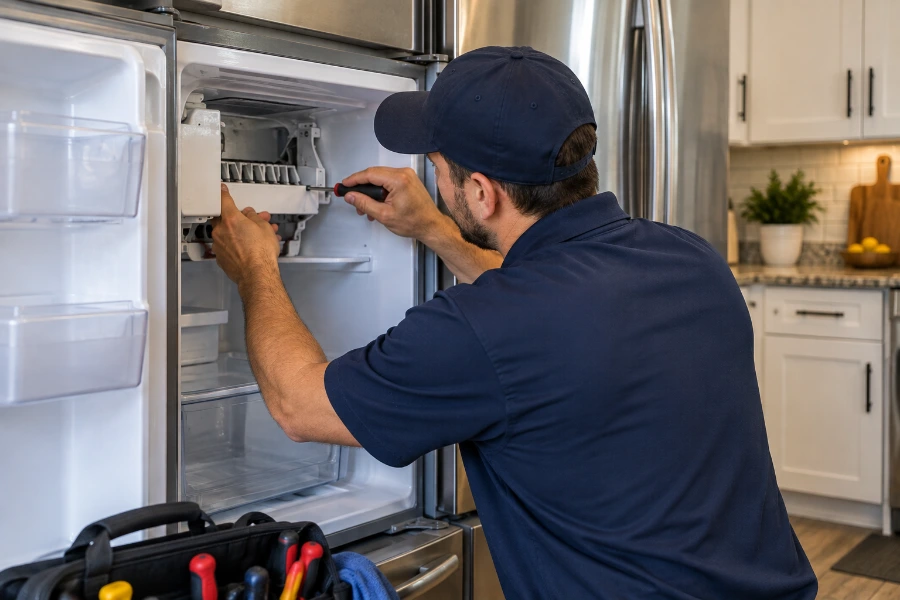
Freezer & Ice Maker Repair Concord, NC
Ice maker stopped working? Freezer not holding temperature? Frost building up inside? We diagnose the actual cause before recommending any parts replacement — serving Concord, Harrisburg, Kannapolis, and surrounding Cabarrus County.
What Your Ice Maker Actually Does — and Why It Fails
Most ice maker problems are upstream of the ice maker itself. Understanding the harvest cycle makes it clear why replacing the assembly is often the wrong first step.
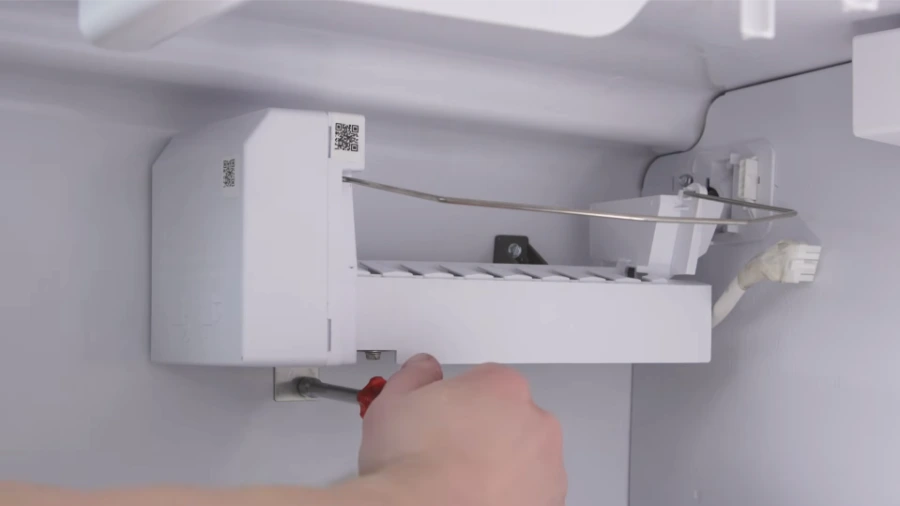
A refrigerator ice maker runs a harvest cycle: water fills the mold, the freezer brings it to around 15°F, a mold heater warms the mold just enough to loosen the cubes, and the ejector arm sweeps them into the bin. The bail arm (the wire arm over the bin) acts as an electrical switch — when it’s up, the ice maker runs; when ice pushes it up, it stops. On newer LG and Samsung models, optical sensors replace the mechanical bail arm entirely.
This sequence has five things that can fail independently: water supply, temperature, mold heater, ejector motor, and shutoff mechanism. A diagnosis that skips straight to replacing the ice maker assembly without checking the others is likely to fail — and that’s exactly what we hear from homeowners who replaced the assembly themselves and still have no ice.
Freezer & Ice Maker Problems We Fix
What We Check, and Why
This is the diagnostic sequence a technician uses. Each step rules out a class of causes before moving to the next — which is why proper diagnosis takes longer than swapping parts, but costs less when it’s done right.
1. Freezer Temperature & Environment
Ice makers require a freezer temperature at or below 10°F to run a complete harvest cycle. Above that, the mold thermostat won’t trigger the ejection sequence regardless of what else is working. We verify actual compartment temperature with a calibrated thermometer — not the dial setting, which can drift — and check for condenser coil restriction in garage units where ambient heat is a factor.
Check the bail arm position first — it’s the first thing homeowners miss. Then check for power at the ice maker wiring plug. Some refrigerator models route ice maker power through the freezer door switch, meaning a partially-failed door switch cuts all ice maker power while everything else functions normally.
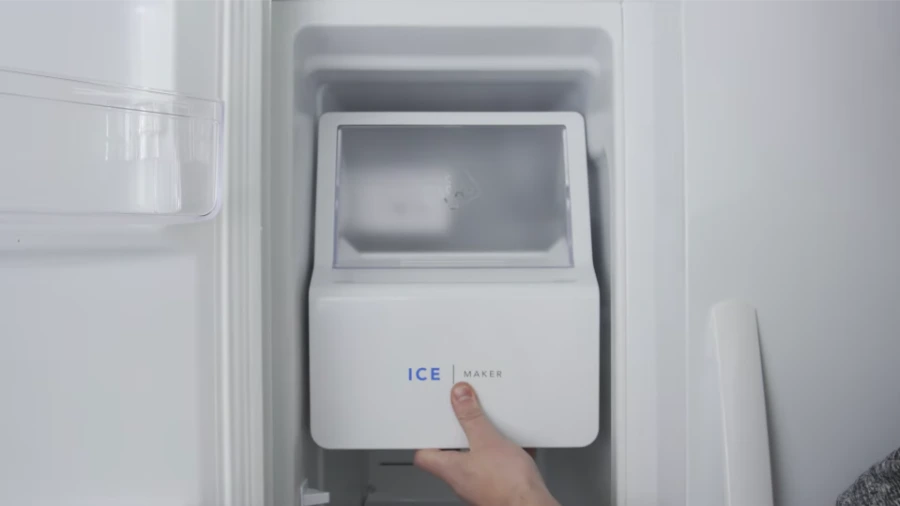
2. Water Supply: Filter, Pressure, and Valve
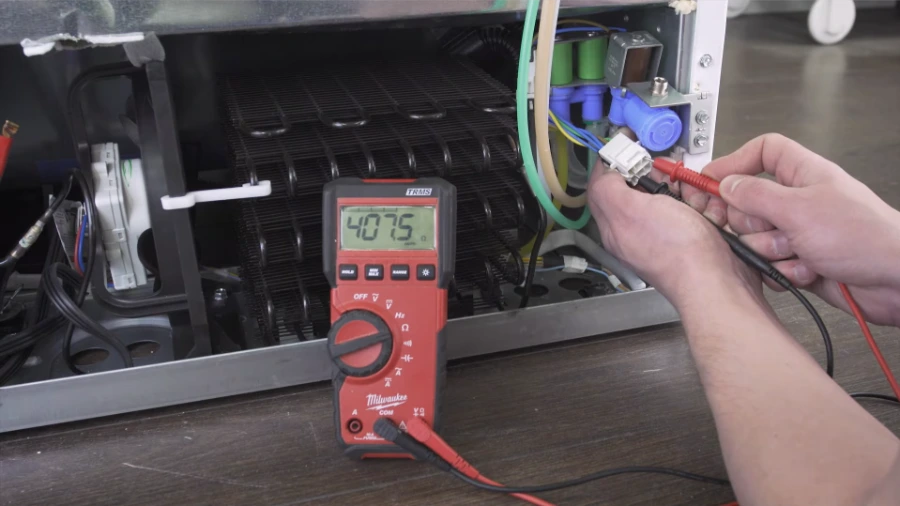
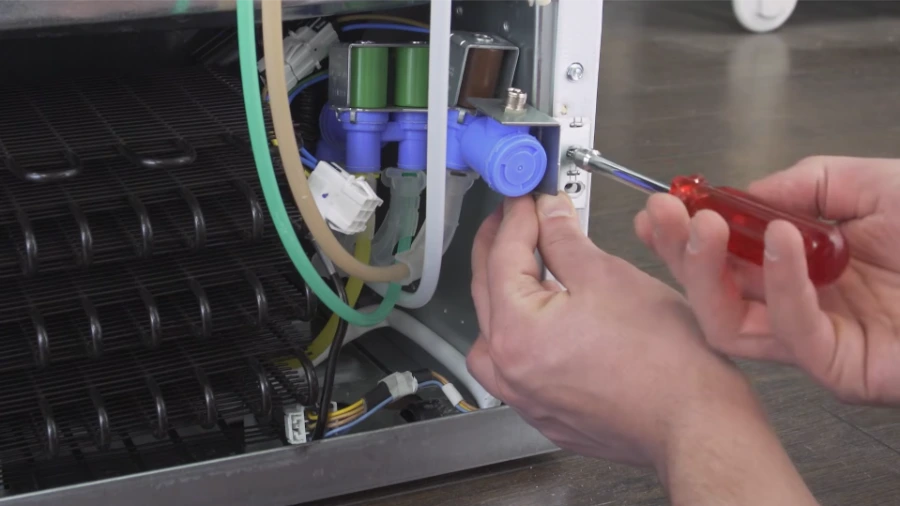
Water has to travel from the household supply line through a shutoff valve, a filter, and a solenoid inlet valve before reaching the ice maker. Any restriction along that path produces undersized ice or no ice at all. We check filter age and condition first, then test water pressure at the valve inlet (needs at least 20 psi), and then test the valve solenoid coils for correct resistance.
A valve that fails closed means no water gets through and the ice maker gets nothing. A valve that fails open — or that seeps — means water trickles through continuously, which freezes in the fill tube and causes recurring ice maker freeze-over. A valve that fails intermittently causes the maddening pattern homeowners describe as “works sometimes, stops randomly” — because the solenoid opens fully some cycles and partially others.
3. Ice Maker Module: Mold Heater, Motor & Thermostat
The ice maker module contains the mold heater, the harvest thermostat, and the ejector motor. On Whirlpool-platform ice makers (which includes many Whirlpool, Maytag, KitchenAid, and some Kenmore units), the mold heater is the most common failure point. Testing it requires checking the heater element for continuity and verifying the thermostat trips at the correct temperature to initiate harvest.
On most residential units the module assembly is a single replaceable part, so component-level repair versus assembly replacement is a judgment call based on the fridge’s age and the part cost. What matters is confirming the module is actually the problem first — not replacing it and then discovering the inlet valve or fill tube was the real cause.
4. Standalone Freezer: Defrost System
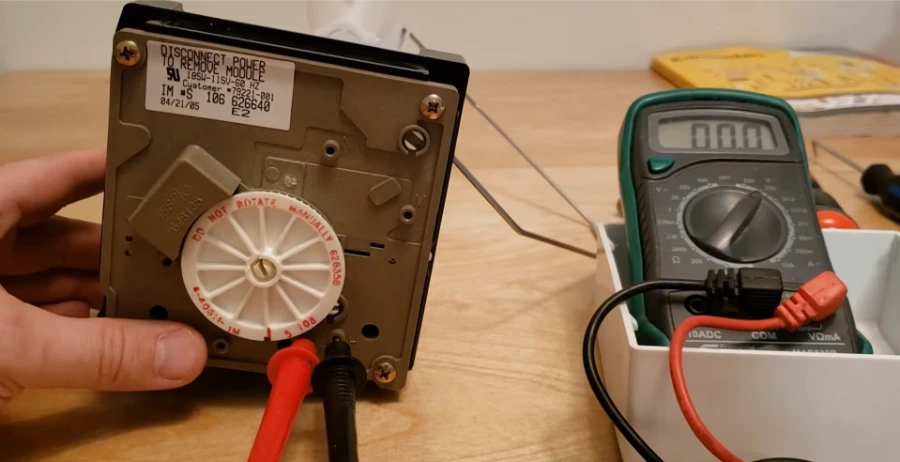
Freezers that progressively lose cooling — not an overnight failure but a gradual decline over weeks — and show frost accumulation on the evaporator coil are almost always dealing with a defrost system failure. The system has three components that work in sequence: the defrost heater melts accumulated frost, the defrost thermostat prevents overheating, and the defrost timer (or adaptive defrost control board on newer models) determines how often the cycle runs.
This is the third element: the defrost timer or adaptive defrost module. On older mechanical-timer freezers, the timer motor itself can fail, preventing the defrost cycle from ever initiating even if the heater and thermostat are functional. On newer freezers with electronic adaptive defrost, the control board determines defrost frequency based on door-open history — a failed board logic can skip defrost cycles indefinitely.
Almost always yes. Frost accumulation from a failed defrost system eventually melts during any passive warming event — a power outage, a door left open — and the water has to go somewhere. If the defrost drain is partially clogged, it overflows into the freezer floor and leaks through the bottom of the refrigerator or onto the floor. Manual defrosting stops the leak temporarily, but the defrost component that failed needs to be replaced to prevent it recurring. This is almost never a reason to buy a new refrigerator.
Safe Checks You Can Do Yourself
These checks don’t require tools or opening anything. If all four are clear and the problem persists, the fault is in a component that requires proper diagnosis.
- Bail arm position: The wire arm over the ice bin should be in the down (run) position. If it’s stuck up — either manually or by an ice jam — the ice maker stops. Clear any ice jam and return the arm to the down position.
- Freezer temperature: Use a thermometer (a basic appliance thermometer works) to check the actual temperature inside the freezer. The dial or digital display can read correctly while the actual compartment temperature is too warm. Target: 0°F to 5°F for freezers, 0°F to 10°F for ice maker operation.
- Water filter age: Most manufacturers recommend replacing the water filter every 6 months. An overdue filter restricts flow enough to produce small, hollow, or no ice. Check the filter replacement indicator if your fridge has one, or look at the filter change date if you track it.
- Water supply valve: Find the water shutoff valve behind or under the refrigerator — it’s the small valve on the household supply line. Make sure it’s fully open. Partially closed valves after a move or kitchen repair are a surprisingly common cause of ice maker problems.
Yes. Raising the bail arm to the up (off) position stops ice production without disconnecting anything. If you want to fully deactivate it, turn off the water supply valve at the wall behind the refrigerator. Avoid disconnecting the water line at the refrigerator fitting without capping it properly — an improperly capped line can leave a slow drip. An unused ice maker with the bail arm raised has no effect on the refrigerator’s cooling.
When to Fix It — and When to Move On
The general 50% rule applies: if repair cost exceeds half the replacement value of the appliance, replacement is usually the better financial decision. But the actual math depends on the failure type and the unit’s age.
| Failure | Typical Repair Cost | Verdict | Notes |
|---|---|---|---|
| Water filter replacement | $35–$70 DIY | Always repair | Maintenance item, not a failure |
| Water inlet valve | $110–$190 | Repair | Simple repair, any age fridge |
| Ice maker assembly replacement | $150–$290 | Repair if fridge <10 yrs | Confirm upstream cause first |
| Defrost heater + thermostat | $150–$260 | Repair | Good ROI on most units |
| Defrost timer / control board | $150–$320 | Repair if fridge <10 yrs | Board cost varies by brand |
| Evaporator fan motor | $130–$220 | Repair | Common on older chest freezers |
| Door gasket | $90–$170 | Repair | Prevents frost entry, good ROI |
| Sealed system / compressor | $400–$800+ | Replace if >7 yrs old | Evaluate against unit value |
Freezer & Ice Maker Repair Costs
All Major Freezer & Ice Maker Brands
We carry parts and have platform-specific knowledge for all common residential brands. LG and Samsung ice maker systems have distinct failure patterns from Whirlpool-platform units — we diagnose them accordingly.
We also handle full refrigerator repair in Concord, including cooling problems, compressor issues, and LG linear compressor failures — which are a separate service from ice maker repair. See also: washer repair, dryer repair, and dishwasher repair.
How a Service Call Works
Call or Contact
Describe the symptom — “ice maker stopped making ice,” “freezer keeps frosting up” — and we’ll tell you what to expect and schedule a visit.
Diagnosis
We test the actual components — not just a visual inspection. The diagnostic visit covers the full sequence from temperature check through component testing.
Written Quote
We tell you exactly what failed, what replacing it costs, and whether repair makes sense for your appliance’s age and condition. No pressure either way.
Repair
Most common repairs complete in a single visit. If a part needs to be ordered, we schedule the return trip and keep you updated.
Most common repairs — inlet valve, ice maker module, fill tube, door switch — complete in a single visit of 1–2 hours. If a part needs to be ordered, we schedule the return trip. After a valve or module replacement, allow 24 hours before expecting the first full batch of ice, since the mold and water supply need to return to operating temperature.
Serving Concord and Cabarrus County
We serve residential customers throughout Concord, NC and the surrounding area — including Kannapolis, Harrisburg, Midland, and Mt. Pleasant.
Concord neighborhoods served include Afton Village, The Farm, Weddington, Cabarrus Station, and surrounding areas. Not sure if we cover your address? Call us — (704) 440-5622 — and we’ll confirm.
Freezer & Ice Maker Repair — Common Questions
Freezer or Ice Maker Not Working?
Honest diagnosis. Transparent pricing. Serving Concord and Cabarrus County.
Mon–Sat · Schedule online