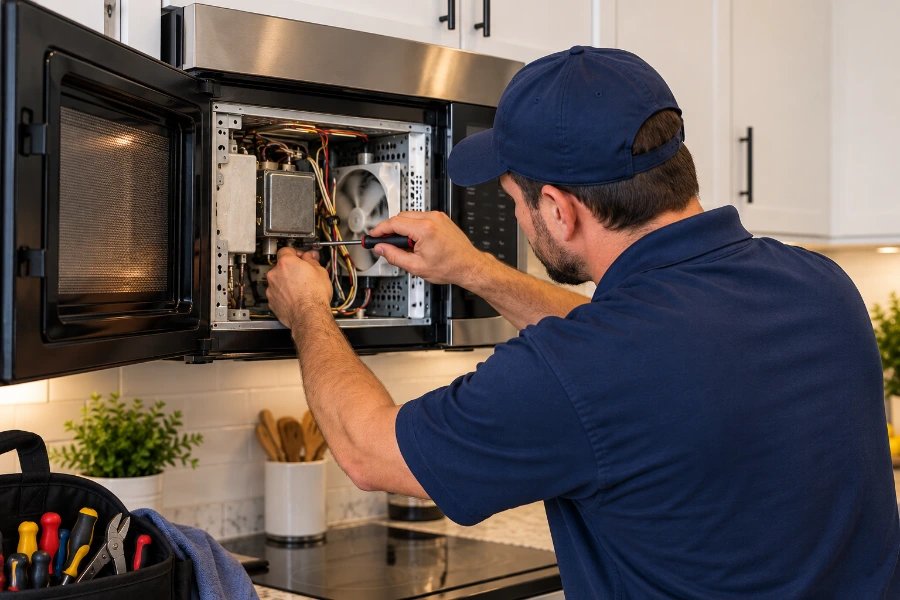
Microwave repair service in Concord NC
Concord, NC & Cabarrus County

Microwave Repair Concord, NC

Microwave not heating? Won’t start? Keeps blowing a fuse? We diagnose and repair over-the-range and countertop microwaves throughout Concord, Harrisburg, and Kannapolis — all major brands. Same-day available.

Countertop & Over-the-Range
Diagnosis First · You Approve Cost Before Any Repair
Licensed & Insured NC
1 Visit
Most Repairs Completed Same Visit
Same Day
Service Available Mon–Sat
All Brands
Countertop · OTR · Built-In
What’s Wrong With Your Microwave

Diagnosing the Problem Starts With the Symptom

Microwave failures follow predictable patterns. The symptom you’re seeing tells a lot about which component is involved — and whether a repair makes sense before we even arrive.
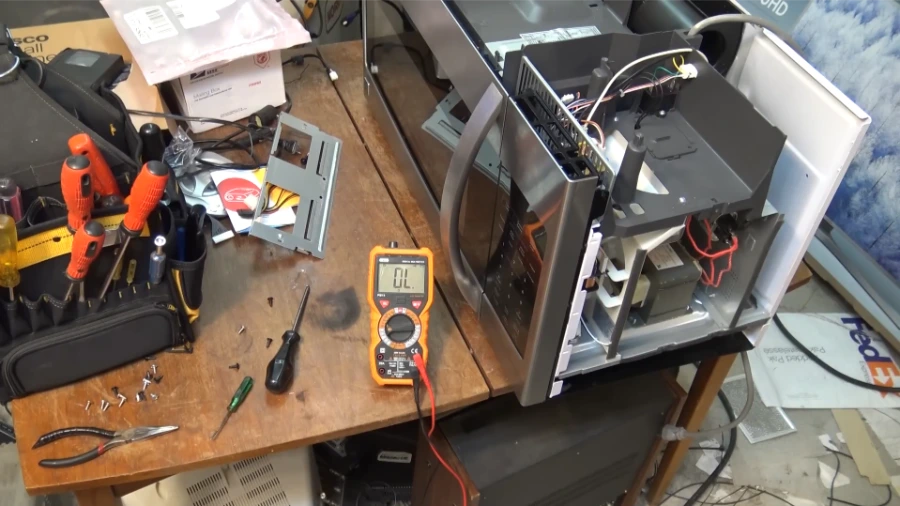
Technician performing microwave diagnostic testing
Diagnostic testing in progress — symptoms guide the diagnostic sequence before any component is touched
Display Is Completely Dead — Nothing Responds
When there’s no display, no light, nothing — the microwave has lost power entirely. The first place a technician looks is the main ceramic fuse at the AC input, which blows to protect the circuit when something shorts downstream. Thermal cutoff switches, which open when the microwave overheats, can produce the same symptom. In most cases, a blown fuse has a cause — finding that cause matters as much as replacing the fuse itself.
Main Fuse · Thermal Cutoff · AC Input Board
Display Works, But Pressing Start Does Nothing
If the clock works and the light comes on but Start does nothing — no fan, no turntable, no heat — a door interlock switch is the most common cause. Microwaves use a system of two or three door switches (depending on model) that must all engage in the correct sequence for cooking to begin. A single failed switch can disable the entire heating circuit while leaving the display fully functional.
Door Interlock Switch · Door Sensing Switch · Control Board
Often a straightforward repair — not a magnetron problem
Counts Down But Doesn’t Heat Food
A timer counting down while fans and turntable run normally means the door sensing switch is working — the board received a door-closed signal. But heat requires the high-voltage circuit to activate. This symptom points to the high-voltage section: the relay on the control board, the high-voltage capacitor, the diode, or in less common cases the magnetron itself. The diagnosis sequence matters here: the relay and diode are tested before the magnetron.
Control Board Relay · High-Voltage Capacitor · HV Diode · Magnetron
Fuse Keeps Blowing — Or Trips the Breaker
A fuse that blows immediately when you plug in (before pressing Start) suggests a short in the high-voltage capacitor or, more commonly, a door switch timing issue. Microwaves have a monitor switch whose job is to blow the fuse if the primary door switch fails to open properly — a worn switch bracket can cause these switches to activate in the wrong sequence. Simply replacing the fuse without finding the underlying cause will result in another blown fuse.
Monitor Switch · Primary Interlock Switch · Switch Bracket · HV Capacitor
Microwave Made a Pop or Flash — Now Dead
A sudden pop or spark followed by a completely dead microwave is almost always a protective event — the main fuse blew in response to an arc inside the cavity or a component failure. The microwave may be entirely repairable. What caused the arc needs to be identified: it could be a damaged waveguide cover, metal accidentally left inside, or a component failing internally. Stop using the microwave until it’s inspected.
Main Fuse · Waveguide Cover · Magnetron · Arcing Cause
Often fixable — don’t assume the worst until diagnosed
Sparking Inside the Cavity
Sparking inside a running microwave is most commonly caused by a damaged or food-contaminated waveguide cover — the flat panel on the interior wall that protects the magnetron antenna. Grease and food debris carbonize and begin to arc. Stop using the microwave immediately: continued use with a damaged waveguide cover can destroy the magnetron, turning a low-cost repair into a much more expensive one. Metal items left inside are another common cause.
Waveguide Cover · Magnetron Antenna · Foreign Material
Turntable Won’t Spin
A turntable that’s stopped rotating has a failed turntable motor in the vast majority of cases. The motor is located under the floor of the cavity and is straightforward to access and replace. A cracked drive coupling is a less common but also easy-to-address cause. This is one of the lower-cost microwave repairs and doesn’t involve the high-voltage section.
Turntable Motor · Drive Coupling · Roller Guide
Microwave Seems to Run Without Pressing Start
If your microwave starts by itself when plugged in, or appears to run with the door open, a door sensing switch has likely failed in the “closed” position — sending a constant “door closed” signal to the control board. This should be repaired promptly. The related symptom of interior light or fan running continuously without input is the same failure presenting differently.
Door Sensing Switch · Control Board · Door Mechanism
A Note on Microwave Repair Safety

Why Microwaves Are Not a DIY Appliance Repair

Most appliance repairs carry manageable DIY risk. Microwave repair is a different category. Here’s what makes it genuinely different — and why it matters.

The High-Voltage Capacitor

The high-voltage section of a microwave operates at thousands of volts to power the magnetron. The high-voltage capacitor stores this charge — and it retains it even after the microwave is unplugged. A technician who opens a microwave without properly discharging the capacitor first is at serious risk, regardless of how long the unit has been unplugged. Every professional microwave technician treats capacitor discharge as a mandatory first step, every single time.

This is the core reason microwave internals are a different risk level from other appliance repairs. Other appliances carry shock risk from live circuits; microwaves add the stored-charge hazard from a capacitor that can retain dangerous voltage for hours.
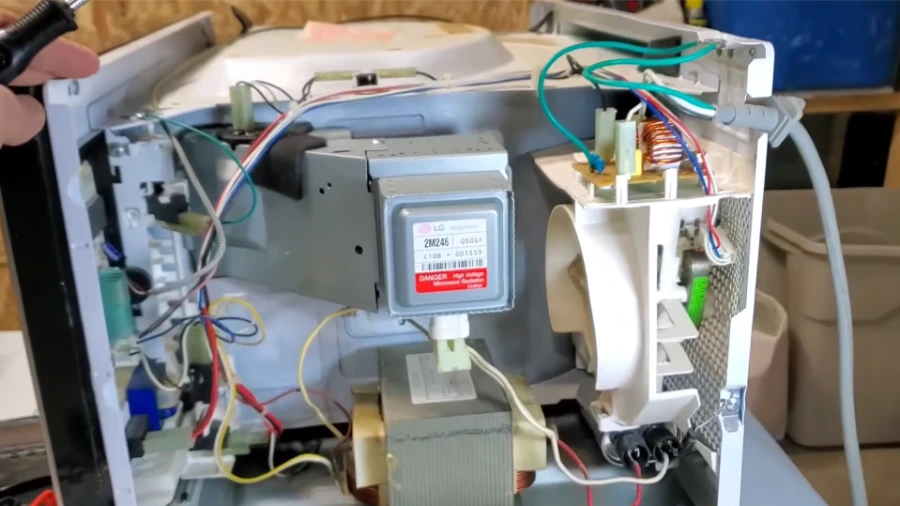
Microwave magnetron inspection during professional service
The magnetron and surrounding high-voltage components require proper capacitor discharge before any safe inspection can begin

When Should I Stop Using My Microwave?

Unplug your microwave and call for service if you notice any of the following: the unit starts on its own or runs without pressing Start; the door doesn’t close and latch firmly; you see arcing, sparking, or smoke inside the cavity during operation; there is a persistent burning smell that doesn’t come from food; or the unit goes completely dead after a pop or flash. These symptoms indicate something is wrong beyond normal wear — continued use can cause further damage or, in the case of door faults, a safety concern.

A note on internet DIY guides: Microwave repair videos exist in abundance online. If you choose to watch them for educational purposes, they can be genuinely informative. But the technicians producing those videos have test equipment, insulated tools, and practiced discharge procedures. The capacitor discharge step is not optional. A competent repair technician follows it every time — and that’s part of what you’re getting when you call a professional.

Repair or Replace?

The Honest Answer to “Is It Worth Repairing?”

The internet often says microwaves aren’t worth repairing. That’s sometimes true — and sometimes completely wrong. The answer depends on what failed, and what type of microwave you have.

Why “It’s Not Worth Repairing” Is Often Wrong

The most common microwave failures — door interlock switches, thermal fuses, and the main ceramic fuse — are low-cost components. A microwave that won’t start, won’t heat, or keeps blowing a fuse is more often a switch or fuse problem than a magnetron problem. Someone who replaces a $150 microwave because a door switch failed has spent considerably more than a repair would have cost. The community advice to “just buy a new one” is well-intentioned but frequently skips the diagnosis step entirely.

The more expensive scenario — magnetron replacement — is where the math genuinely tilts toward replacement for basic countertop units, because the part and labor cost can approach or exceed what the microwave is worth. That’s an honest tradeoff, and we tell clients the same.

Unit Type Changes the Calculation Significantly
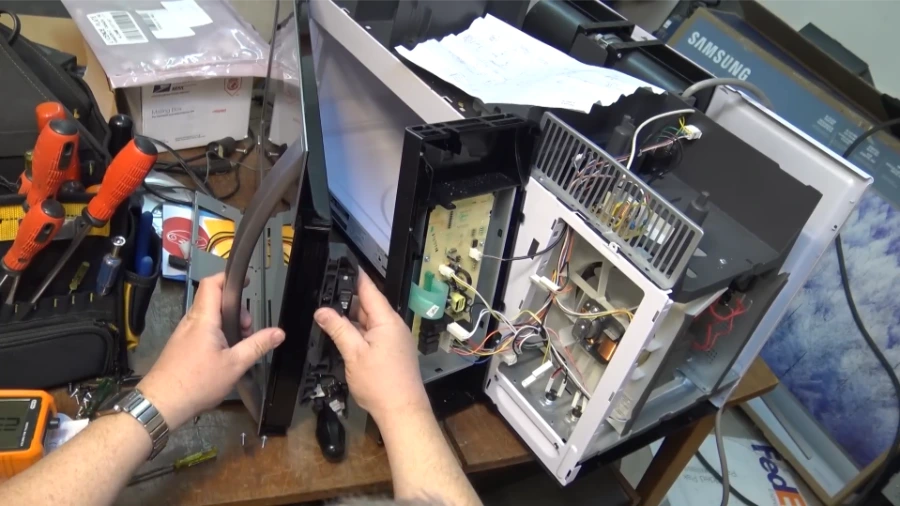
Microwave control panel removal during service
Control panel access during service — OTR and built-in microwaves require more disassembly, which shifts the repair economics compared with a countertop unit

Basic countertop microwaves (under $150 retail): If the repair cost approaches replacement cost, we’ll say so. For simple repairs — switch, fuse, turntable motor — it usually still makes sense. For magnetron or control board failures on a budget unit, it often doesn’t.

Over-the-range (OTR) microwaves: Replacing an OTR unit means new parts and installation labor on top of the appliance cost. Even a moderately expensive repair is typically the better financial choice. We’ll give you an honest assessment after diagnosis.

Built-in or integrated microwave drawers: These have even higher replacement and installation costs. Repair viability extends further here, and we approach each case the same way — tell you what it will cost, and whether it makes sense.

The Age Question

Age alone isn’t a disqualifier for repair. A ten-year-old over-the-range microwave with a failed door switch is almost always worth repairing. A two-year-old budget countertop with a failed magnetron may not be. The component that failed and the cost to replace it matter more than the calendar.

Repair Usually Makes Sense When…
  • The failure is a door switch, fuse, or thermal cutoff
  • It’s an over-the-range or built-in unit (higher replacement cost)
  • The microwave is a higher-end countertop model worth preserving
  • The repair cost is well under the cost of replacement + installation
  • The turntable motor or waveguide cover has failed
Replacement May Make More Sense When…
  • It’s a basic countertop unit (under $150 retail) with a magnetron failure
  • Control board repair cost approaches or exceeds unit value
  • Multiple component failures are present
  • Parts for an older or discontinued brand are no longer available

We give you this assessment after the diagnostic visit — not as a sales pitch either way. If replacement makes more financial sense for your situation, we’ll tell you.

Before You Call

What to Tell Us When You Call

A few quick observations before you call help us arrive with the right parts and give you a more accurate estimate over the phone. Run through this quick mental checklist.

  • Is the display working, or is the microwave completely dead?
  • If the display works: does the clock count down when you press Start?
  • Do the fans run and does the turntable spin during operation?
  • Is there any heat at all, or none whatsoever?
  • Did it trip a breaker or blow a fuse? (Did it happen when you plugged in, or when you pressed Start?)
  • Did it make a pop, spark, or unusual noise before stopping?
  • What is the brand and model number? (Usually on a label inside the door)
  • Is it a countertop unit or over-the-range?

You don’t need every answer — whatever you can observe helps. Even a partial symptom description is more useful than “it stopped working.”

Transparent Pricing

Microwave Repair Costs in Concord, NC

Common repairs range from straightforward switch replacements to more involved high-voltage component work. These are typical ranges — your exact cost depends on the model and the part involved. We quote before we start any repair.
Door Switch
$90–$150
Won’t start · Fuse keeps blowing
High-Voltage Diode
$100–$170
Runs but doesn’t heat
Turntable Motor
$80–$140
Plate not spinning
Control Board
$140–$260
Display · Function failures
Magnetron
$180–$300
We assess repair vs. replace
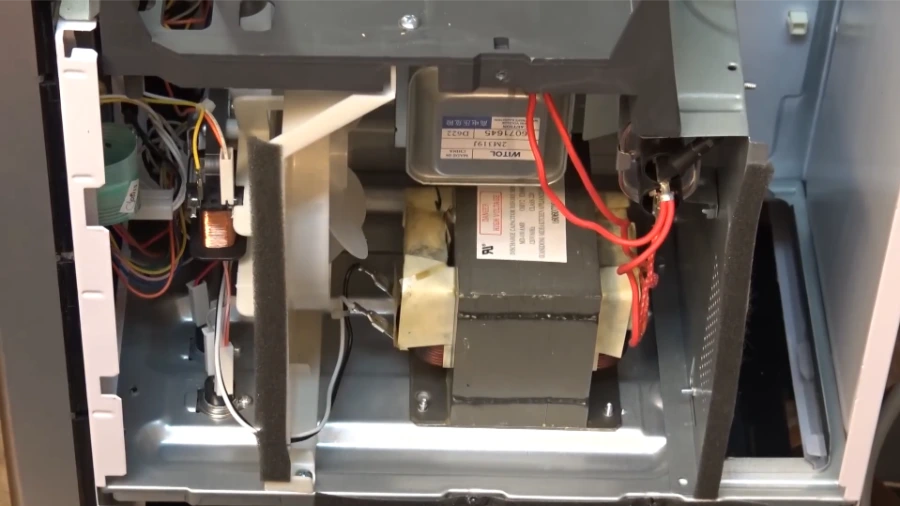
Microwave high-voltage transformer component
The high-voltage transformer is part of the circuit that drives the magnetron — component-level pricing reflects the complexity of high-voltage section repairs
Every repair starts with a diagnosis. If the repair doesn’t make financial sense for your microwave — we’ll tell you that honestly, before any work is done.
Brands We Repair

All Major Microwave Brands Serviced

We repair countertop, over-the-range, and built-in microwaves across all major manufacturers, including standard and inverter-based models. If your brand isn’t listed here, call us — we service most brands.

Samsung LG GE Whirlpool KitchenAid Frigidaire Panasonic Sharp Maytag Kenmore

We also repair other appliances serving Concord and Cabarrus County — see our refrigerator repair, washer repair, and oven and range repair pages for more.

Service Area

Microwave Repair Across Concord and Cabarrus County

We serve homeowners throughout Cabarrus County — from established neighborhoods in Concord to newer communities in Harrisburg and Midland.

Concord, NC — primary service area
Kannapolis, NC — full coverage
Harrisburg, NC — same-day available
Midland, NC — extended coverage
Mount Pleasant, NC — extended coverage
28025
28026
28027
28078 — Harrisburg
28081 — Kannapolis
Common Questions

Microwave Repair — What People Ask Us

Not at all — and this is one of the most common misconceptions about microwave repair. When a microwave runs normally (display, fans, turntable) but produces no heat, the problem is somewhere in the high-voltage circuit — but the magnetron is the last component a technician checks, not the first. The control board relay, the high-voltage diode, and the capacitor are all tested before the magnetron, because they fail more frequently and cost less to replace. In many cases, a “no heat” microwave has a diode or relay problem, not a magnetron problem.
It depends on the failure and the unit type. For over-the-range microwaves, repair is almost always worth considering — the cost of replacing an OTR unit and having it installed is substantial. For basic countertop models under $150 retail, a magnetron or board failure may not justify repair, but simpler failures (switches, fuses, turntable motor) usually will. We give you an honest assessment after diagnosis: what the repair will cost, what replacement would realistically cost for your unit type, and our honest read on which makes more sense. We don’t push repair when replacement is the smarter call.
Recurring fuse failure means something is causing a short — and simply replacing the fuse without finding the cause will result in the same problem again. The most common causes are door interlock switch failures (specifically the monitor switch, which blows the fuse intentionally if another switch fails to open in time) and a worn switch bracket that causes switches to fire in the wrong sequence. A shorted high-voltage capacitor is another possible cause. The symptom of fuse blowing when you plug in (before pressing Start) versus when you press Start can help a technician narrow the cause quickly.
Sparking inside the microwave cavity is almost always caused by a damaged or soiled waveguide cover — the flat panel inside the cavity wall that protects the magnetron antenna opening. Food debris carbonizes on the cover and begins to arc. Stop using the microwave immediately: a damaged waveguide cover left in place during operation will eventually destroy the magnetron, turning a low-cost repair into a much more expensive one. The cover itself is a low-cost part. If no cover damage is visible, also check whether any metal items have been inside — foil, twist ties, or utensils — which can cause the same arcing.
Yes. We repair countertop, over-the-range (OTR), and built-in microwaves. OTR and built-in units involve more access work than a countertop unit, which is reflected in the labor, but the repair economics are also different — replacing an OTR unit with installation can cost significantly more than repairing one. If you have a built-in or integrated model, call us and we’ll give you an upfront quote before scheduling a visit.

Microwave Not Working?

Same-day appliance repair in Concord across Cabarrus County.

(704) 440-5622