Washer Repair Concord
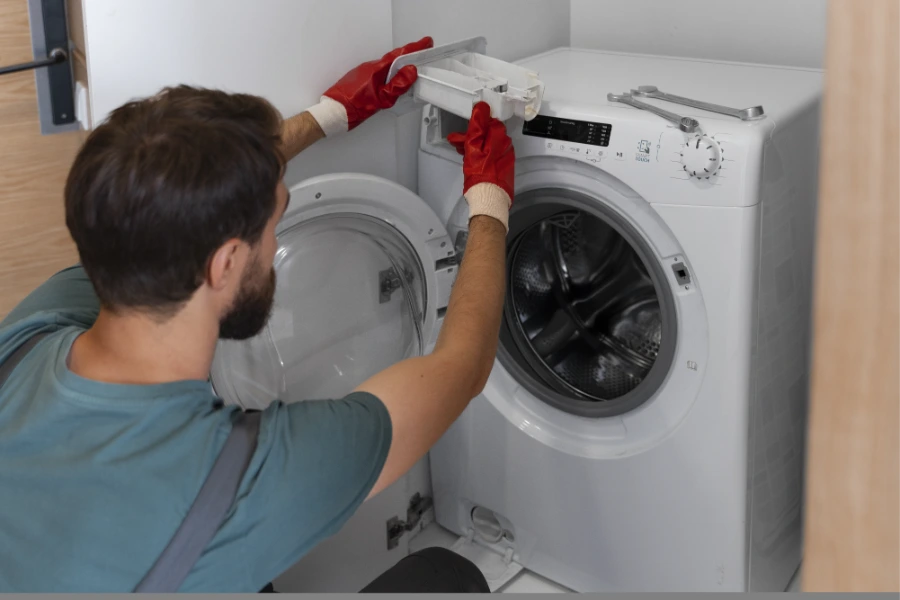
Won’t spin? Not draining? Shaking the house? We diagnose and repair washing machines throughout Cabarrus County — same day in most cases. All brands, including LG and Samsung.
Washing Machine Repair Starts With the Right Diagnosis
Most washing machine failures come down to a specific failed component — not the whole machine. Every service call begins with a methodical on-site diagnostic, because putting parts in without confirming the root cause is one of the most common ways a repair ends in frustration.
Across hundreds of service calls on residential washers — both top-loaders and front-loaders, old machines and new — the same patterns emerge. Some problems show up constantly; others are rarer but misdiagnosed often. The sections below cover the problems we encounter most frequently, what causes them, and how a technician works through the diagnosis.
If your washer is a Whirlpool, Maytag, Samsung, LG, GE, Kenmore, or another major brand, there’s a good chance we’ve repaired that exact model before. Call us at (704) 440-5622 to schedule service in Concord or a nearby community.
Not sure what’s wrong? That’s normal — and that’s what the diagnostic is for.
You don’t need to know which part failed before you call. Describe what the machine is doing, when the problem happens in the cycle, and what sounds you’re hearing. That information helps us arrive prepared and get the repair done on the first visit whenever possible.
Washer Fills and Agitates but Won’t Spin
This is one of the most common calls we receive: the washer runs through its fill and wash cycles normally, drains the water, then leaves clothes sitting in a soaking wet tub with no spin.
Why does my Whirlpool or Maytag washer agitate but refuse to go into a final spin?
On Whirlpool and Maytag top-loaders, a faulty shift actuator is one of the most frequent causes. This small component switches the washer between agitation mode and spin mode. When it fails, the machine often completes everything else but never transitions into that final high-speed spin.
The Shift Actuator: How It Works and Why It Fails
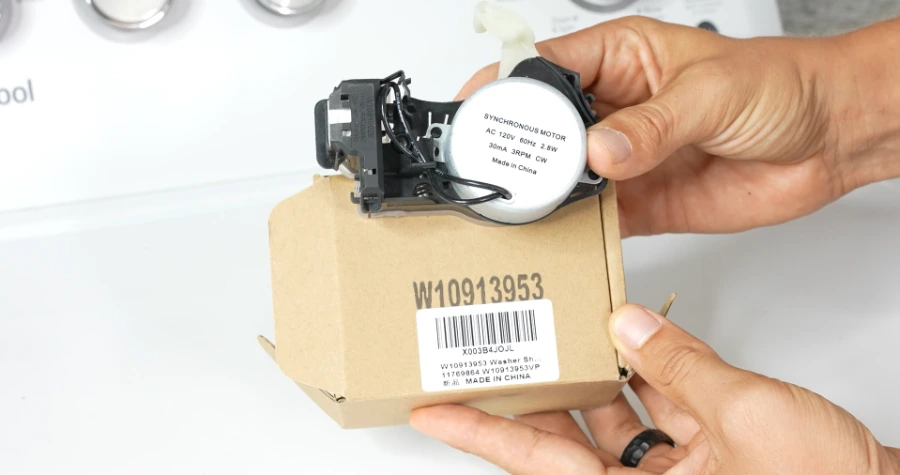
The shift actuator (part W10913953 and related variants) is mounted at the bottom of the machine. A small arm engages a mechanical slot that physically shifts the drive system from agitate to spin. When it fails, the machine fills, washes, and drains normally — then stalls at spin.
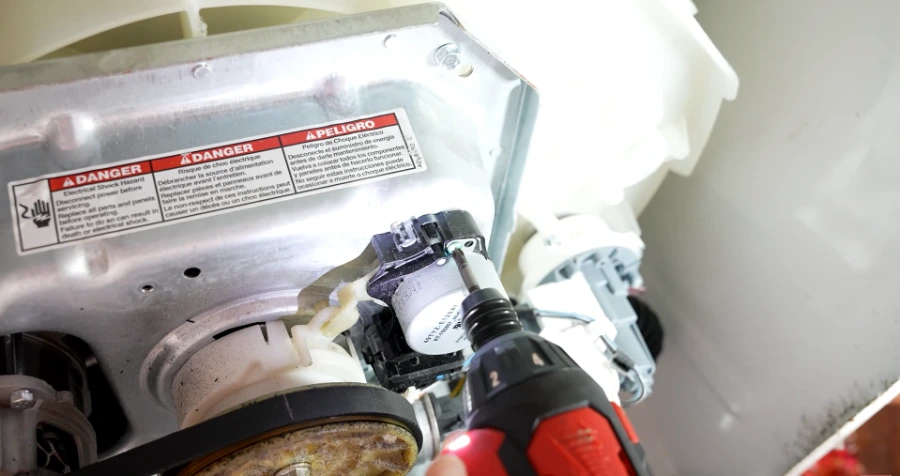
After replacing the shift actuator, the washer must be recalibrated. On most Whirlpool and Maytag models, the recalibration sequence involves turning the selector knob in a specific pattern until all lights flash, then running recalibration from the rinse position. Anytime the actuator, suspension, or hub is serviced, this step applies.
Other Components That Can Cause a No-Spin Condition
Washer Not Draining — or Draining Very Slowly
A washer that won’t drain leaves clothes sitting in water and often throws an error code. Before anything else: check whether the drain hose is kinked or inserted too deeply into the standpipe, and whether there’s excessive suds in the drum.
Can too much soap actually stop a washing machine from draining?
Yes. Excessive suds can prevent water from moving out of the drum properly — this is a documented failure mode often mistaken for a pump problem. HE machines require HE detergent; standard detergent creates far more foam than these machines can handle.
Drain Pump: The Most Common Mechanical Cause
Pumps fail in three main ways: debris in the impeller (a coin or hairpin can shatter the fins), electrically burned motor, or leaking pump housing. A working pump impeller has noticeable resistance when you spin it by hand. Resistance across the pump motor terminals on a multimeter should read between 14 and 25 ohms on most residential models.
Clogged Drain Filter (Especially Front-Loaders)
On most front-load washers, a drain pump filter is accessible behind a small door at the lower front. When clogged, water drains slowly or not at all. To remove without flooding: tilt the front of the washer slightly rearward so standing water shifts toward the back — then the filter housing has much less water when you pull it.
Note on rubber-backed rugs: Washing mats with rubber backing is one of the most reliable ways to destroy a drain pump. The rubber deteriorates and fragments travel into hoses, the pump, and filter — and can burn out the motor.
Washing Machine Making Strange or Loud Noises
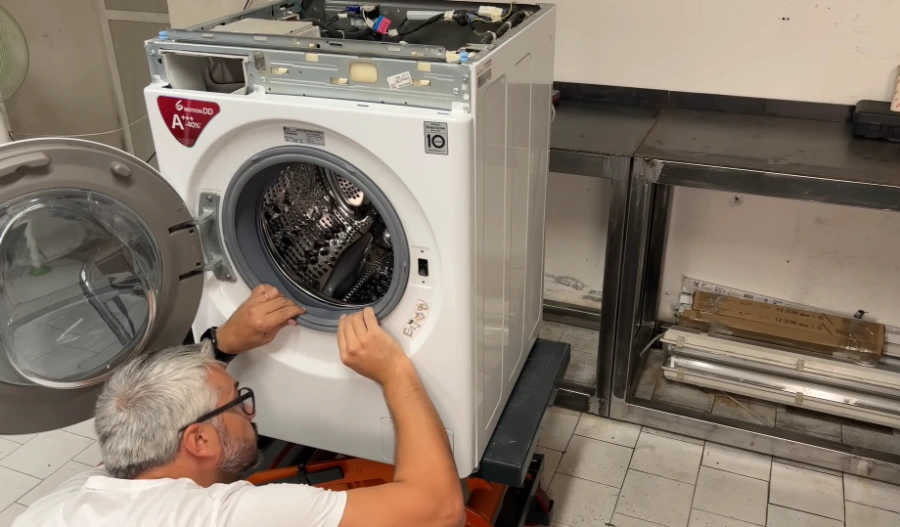
A washing machine that’s suddenly loud is alarming. The sound itself is diagnostic information — where in the cycle it occurs, how it changes with load size, and whether it’s accompanied by vibration all help narrow down the cause.
| Sound | When It Occurs | Possible Cause |
|---|---|---|
| Grinding / roaring | During or building into spin | Transmission / gear case; worn drum bearings |
| Rumbling / thundering | Entire spin cycle | Drum bearings (rear bearing on front-loaders) |
| Banging / thudding | As spin ramps up | Worn suspension rods; tub bearing wear |
| Clicking / ticking | Agitation or spin | Coin in pump; agitator dogs; clutch |
| Grinding during agitation only | Wash / agitation phase | Transmission or gear case; bad clutch |
| High-pitched squeal | Spin cycle | Bearing losing lubrication; motor issue |
| Marbles / rocks falling | Spinning drum by hand | Rear bearing breaking apart |
| Humming with no drain | During drain phase | Debris jamming pump impeller |
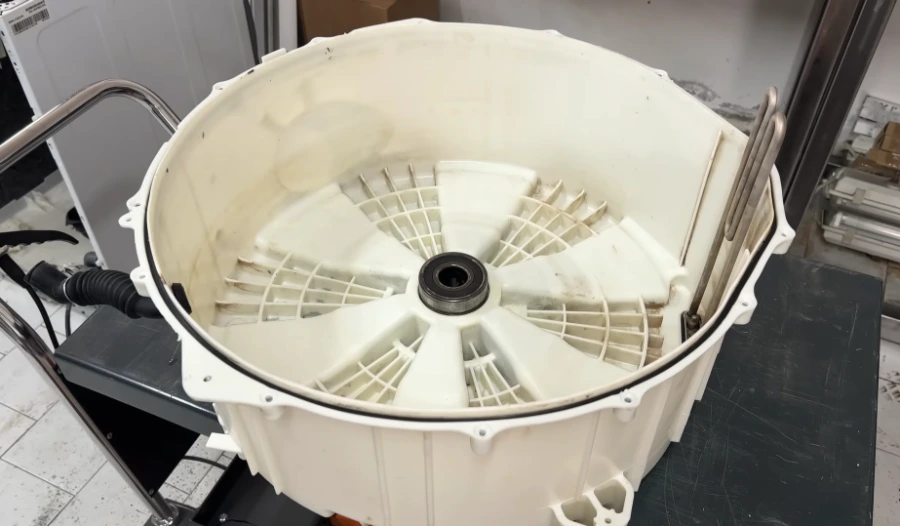
What does a washer with failed drum bearings actually sound like?
A failing drum bearing on a front-load washer often starts as a distant rumble during spin that gradually gets louder. In advanced stages it can be deafening. If you spin the drum by hand with the door open and hear a grinding resistance or ball bearings rolling loose, the rear bearing is a strong suspect.
Washing Machine Shaking, Walking, or Vibrating Excessively
Some vibration during spin is normal. Violent shaking that moves the machine across the floor or rattles throughout the house is not — and if it happens regardless of load size, the cause is almost certainly mechanical.
Why does my washing machine shake violently even when the load seems balanced?
Worn suspension rods, a degraded tub bearing, or a hub assembly that no longer holds the basket true on its shaft can all cause persistent, load-independent vibration. If shaking happens with any load size or distribution, suspect components — not the laundry.
Testing the Suspension System
Open the lid on a top-loader, press down firmly on the tub, then let go. Healthy suspension rods should bounce back once — maybe twice — and settle. If the tub bounces repeatedly or reveals side-to-side looseness, the suspension rods are weak.
Samsung Active Water Jet: A Specific Warning
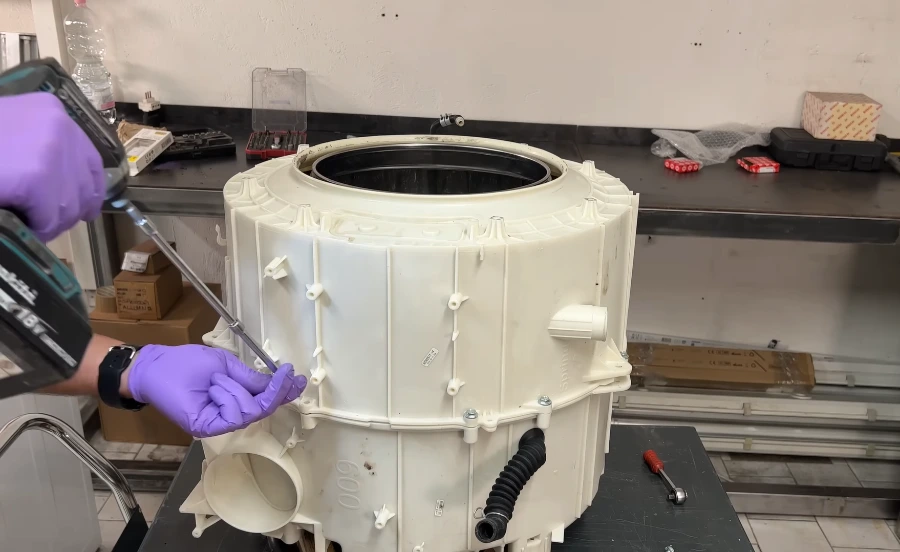
If you own a Samsung Active Water Jet washing machine getting UB or DC error codes with clothes consistently soaking wet — suspension rods are not the cause and will not fix the problem. This specific Samsung design has a known failure mode where the splined hub wears into an hourglass shape. The basket then wobbles by 2–3 degrees on every rotation. The replacement basket assembly (Samsung part DC9716990 and related suffixes) has been discontinued. We’ll confirm parts availability before you commit to any repair cost.
Washer Not Filling, Leaking, or Stopping Mid-Cycle
Washer Not Filling With Water
When a washer fails to fill, eliminate the simple causes first: confirm the hot and cold supply valves are fully open, and check the inlet screens where supply hoses connect to the washer — these small mesh screens can become completely packed after municipal water main work stirs up sediment.
If supply and screens are fine, the fill valve (water inlet valve) may have failed internally — getting power but not opening. A clogged pressure switch hose can also prevent the machine from sensing tub level correctly, causing it to either not fill at all or to overfill.
Washing Machine Leaking — Finding the Source
A leaking washer needs attention quickly; water on a laundry room floor can damage flooring and subfloor. A technician runs the machine through a full cycle watching where water appears and when in the cycle it starts. Water during filling usually comes from supply hoses or the fill valve. Water during agitation may come from a tub seal. Water during drain is often the pump itself.
What causes a front-load washer door seal to leak?
The door bellows (the rubber gasket between the door and the drum) is the most frequent leak source on front-loaders. It can tear from a sharp object in a load, pull away from the tub if a very heavy item is washed, or simply crack with age.
Washer Stops Mid-Cycle or Throws Error Codes
Modern washers monitor themselves. When something is off — a sensor reading outside range, a component not responding — the machine throws an error code and halts. The tech manual for your specific model is often tucked under the top lid, behind the lower kick panel, or behind the front control panel. Searching your brand and model number with the error code online will return specific documentation.
Both top-loaders and front-loaders use a locking mechanism to confirm the lid or door is closed before allowing the cycle to proceed. Most front-loaders have a manual release — a small plastic loop or lever accessible behind the lower kick panel — that unlocks the door without power.
Washing Machine Brands We Repair in Concord
We service all major residential washer brands — top-load, front-load, stackable units, and laundry centers.
We also cover refrigerator repair, dishwasher repair, and dryer repair across Cabarrus County.
Washer Repair vs. Replacement
As a general guideline: if the repair cost is less than half the price of a comparable new machine and the washer is under eight years old, repair usually makes sense. Transmission failures on ten-year-old entry-level machines are the ones to evaluate carefully.
Are there washing machines worth repairing and keeping for a long time?
Yes. Speed Queen machines are built to commercial standards. The Maytag MVWP585GW (commercial-grade model) is built on a separate commercial assembly line with a quad-gear transmission and stainless basket. For some machines — particularly older Samsung models — the needed part simply isn’t available anymore. We will always confirm parts availability before you commit to a repair cost.
Washing Machine Maintenance That Reduces Breakdowns
Serving Concord, NC and Surrounding Communities
Our primary service area centers on Concord, North Carolina — including Harrisburg, Kannapolis, and all of Cabarrus County.
Washing Machine Repair — Common Questions
Ready to Get Your Washer Fixed?
Same-day service in Concord, Harrisburg, Kannapolis, and all of Cabarrus County. We answer live — describe what your machine is doing and we’ll arrive prepared.