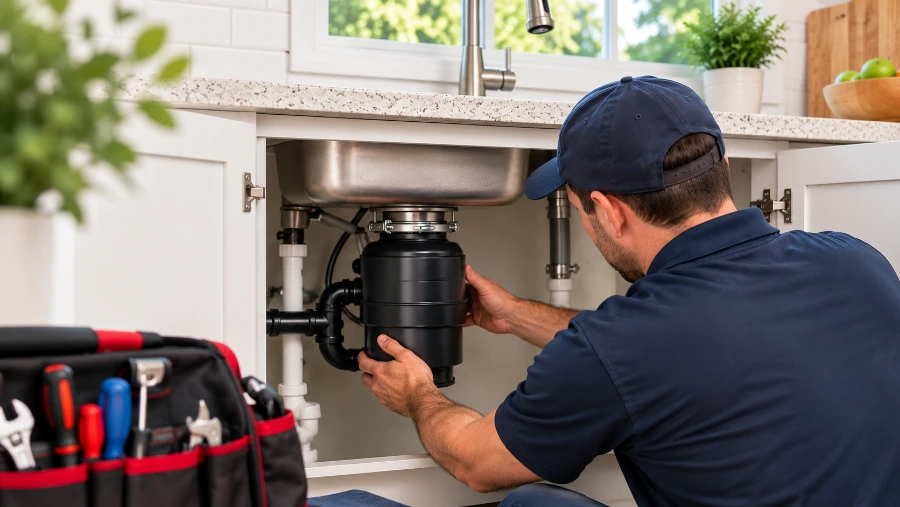
Garbage Disposal Repair in Concord, NC
If your garbage disposal is jammed, won’t turn on, or is leaking under the sink, a technician can usually diagnose the problem in a single visit. We handle garbage disposal repair for homeowners in Concord, Kannapolis, Harrisburg, Mount Pleasant, and Midland — no travel surcharge within our service area.
When Your Garbage Disposal Stops Working
Garbage disposals fail in a handful of predictable ways. Here’s what different symptoms can indicate — though a technician will need to assess the unit in person to confirm the cause and recommend the appropriate repair.
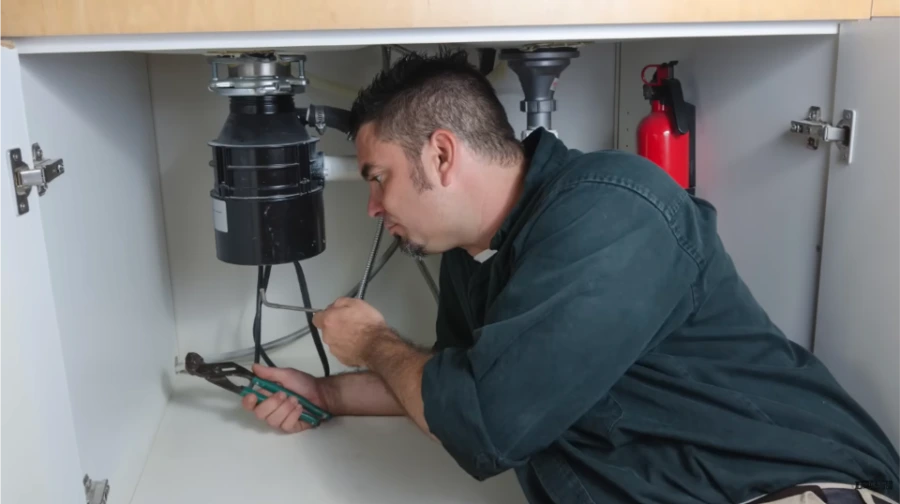
Garbage Disposal Leaks — What the Location Tells You
Where a garbage disposal leaks matters. The location of the leak can point to the repair needed — and in some cases, to whether replacement makes more sense than repair.
Leak at the Top — Sink Flange
A leak at the very top of the disposal — where it connects to the sink drain opening — usually points to a failed mounting gasket or loose mounting hardware. The sink flange sits above the disposal and is sealed with plumber’s putty and mounting hardware. Over time the putty dries out or hardware loosens. This is typically a repairable issue.
Leak from the Side Connections
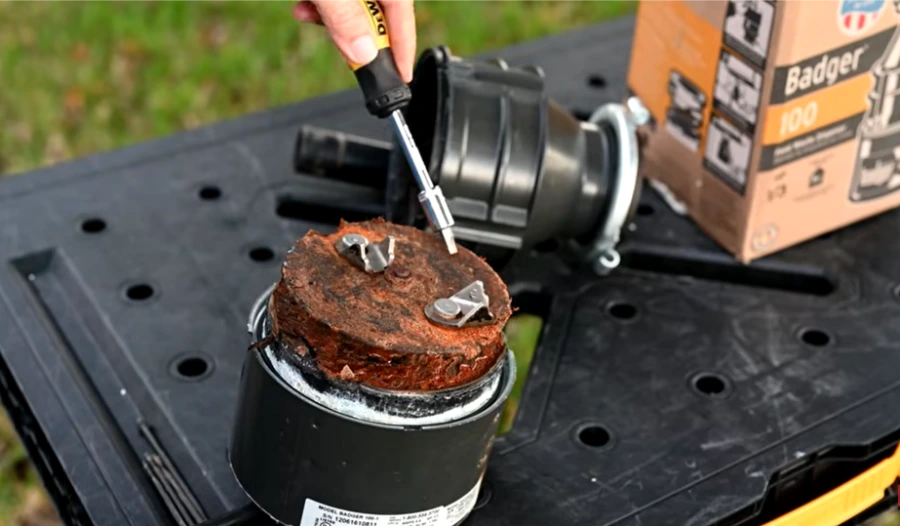
Leaks from the side of the disposal can come from the dishwasher drain connection or from the main drain discharge port. These are typically gasket or clamp failures and are often repairable. If a dishwasher was recently connected or reconnected, the knockout plug inside the disposal inlet may not have been removed — this causes drain problems and sometimes apparent leaks at that connection.
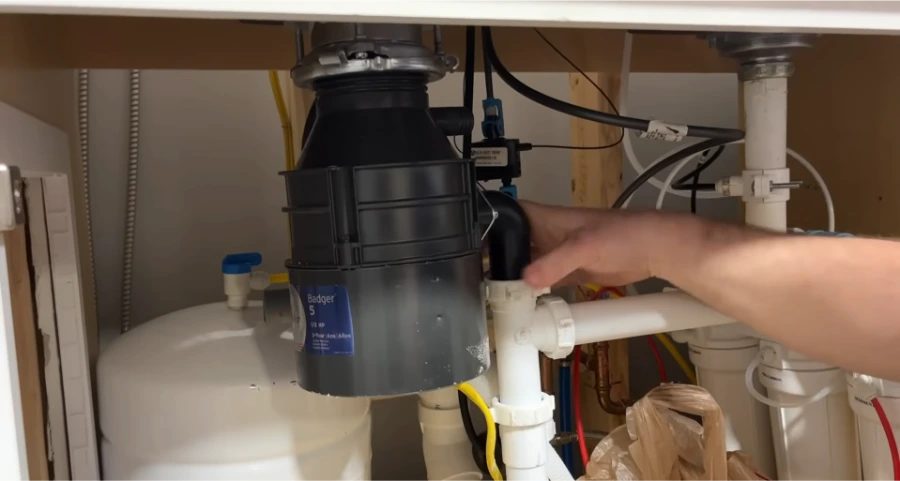
Leak from the Bottom
A leak originating from the bottom of the disposal housing typically points to internal seal failure. When internal seals fail, water leaks through the motor area and drips from the bottom. This type of leak usually indicates that replacement is more cost-effective than repair, particularly on older units.
Is It the Disposal or the Drain? Slow draining from the disposal side of the sink is often blamed on the disposal when the actual problem is a partially blocked drain line or P-trap. The disposal grinds food and sends it into the same drain system as the rest of your kitchen sink — if the drain line has buildup, both the disposal and the other basin will drain slowly. A technician will evaluate whether the issue is the disposal itself or the drain plumbing downstream.
Persistent odor from the disposal area is usually food debris packed into the grinding chamber or lodged in the rubber splash guard. A thorough cleaning — ice cubes, salt, and citrus are commonly recommended — often resolves odor. If odor persists despite cleaning, the unit may have buildup in areas that can’t be reached with surface cleaning.
Running but Not Grinding / Unusual Sounds
Hums but Won’t Spin — What’s Happening Inside
A disposal that hums when you turn it on but doesn’t spin is getting power but the grinding plate is jammed. Something — a bone fragment, a utensil, a bottle cap — may have lodged in the grinding ring. Turn the disposal off immediately; running a stalled motor can cause it to burn out. There is a hex socket on the bottom of most units that allows manual plate rotation, but if the jam isn’t obvious or the disposal continues to hum after clearing, the problem may be mechanical.
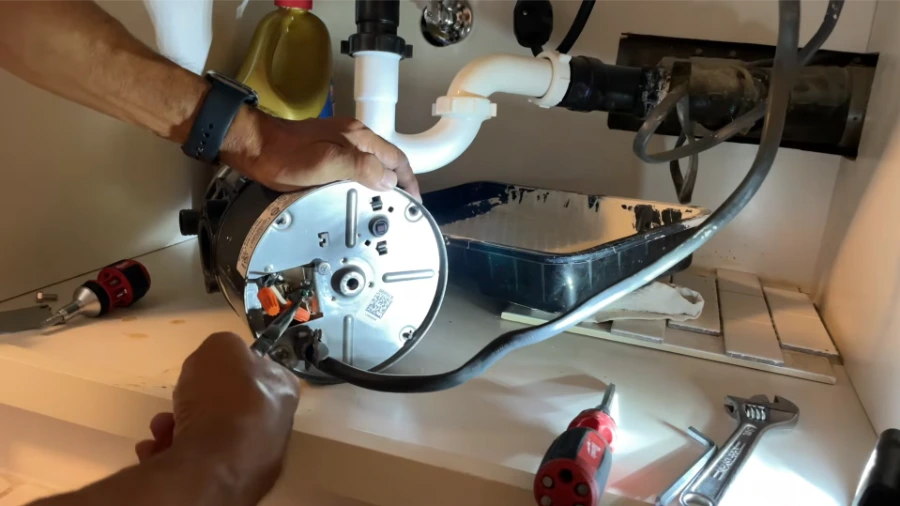
Disposal Runs but Doesn’t Grind Food
If the disposal motor runs — you can hear it operating normally — but food waste isn’t being processed, the impeller plate or grinding ring may be worn or the flywheel may have separated. These are mechanical failures rather than electrical ones and typically require component replacement or full unit replacement depending on the extent of the wear.
Loud Grinding or Rattling
Unusual grinding or rattling sounds can indicate a foreign object in the grinding chamber, worn bearings, or loose internal components. If the disposal is making a metal-on-metal sound, turn it off. Continuing to run it can cause additional damage. A technician will remove the disposal from the mounting to inspect the grinding chamber and internal components.
Your Disposal and the Dishwasher
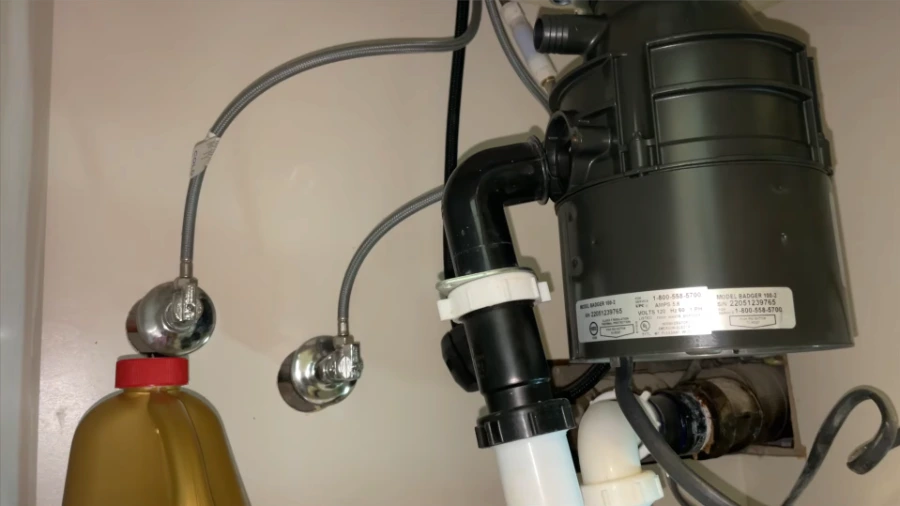
If your home has a dishwasher, its drain hose typically connects directly to a port on the side of the garbage disposal rather than going straight to the drain pipe. This means a jammed or failing disposal can affect dishwasher drainage — and vice versa. If your dishwasher is draining slowly or backing up at the same time your disposal is having problems, the two issues may share a common cause.
One installation detail that sometimes causes problems: when a new disposal is installed to replace a unit that didn’t have a dishwasher connection, the knockout plug inside the dishwasher inlet port must be removed before connecting the dishwasher drain hose. If it wasn’t removed, the dishwasher won’t drain and water may back up. A technician will check this if dishwasher drain issues and a recent disposal installation are both in the picture.
If you’re having problems with your dishwasher separately, Concord Appliance Care also handles dishwasher repair in Concord across Cabarrus County.
Burning Smell or Electrical Symptoms
If you smell burning from the disposal area: A burning smell can indicate motor overheating, a stalled motor drawing excess current, or an electrical problem at the wiring connection. Turn the disposal off at the wall switch and at the circuit breaker before doing anything else. Do not attempt to disassemble the unit or access the wiring without first cutting power at the breaker. If the burning smell is accompanied by tripped breakers, visible scorching, or the smell of melting plastic, treat it as an electrical issue and have a technician assess it before using the disposal again.
Should You Repair or Replace Your Garbage Disposal?
Garbage disposals are less expensive to replace than most other kitchen appliances, which means the repair-vs-replace question comes up more often here than it does with a refrigerator or a washer.
- The problem is a specific, isolated component
- Leaking flange gasket or failed switch
- Simple mechanical jam in a relatively new unit
- Unit is under 8–10 years old
- Repair cost is well below replacement cost
- Motor has failed or burned out
- Internal seals have failed (bottom leak)
- Unit is 10–12+ years old
- Multiple things going wrong at once
- Repair cost approaches cost of a new unit with installation
A diagnostic visit covers the full assessment. After looking at your disposal, a technician will tell you what the problem is and what repair would cost — or whether replacement is the more sensible path. Any diagnostic cost applies toward the repair if you proceed. You’re not obligated to move forward after the diagnostic.
How Garbage Disposal Repair Works Here
When you call, we’ll schedule a diagnostic visit. A diagnostic visit covers the technician’s time to assess the disposal at your home. If you decide to move forward with the repair, the diagnostic cost applies toward the total — it’s not a separate charge on top of the repair cost.
At the visit, a technician will inspect the unit, identify the problem, and give you a clear picture of what the repair involves and what it costs. If the repair makes sense, many disposals can be repaired the same day. If parts need to be ordered, we’ll schedule a follow-up. If replacement is the better choice, we’ll tell you that honestly before doing any work.
We serve homeowners in Concord, Kannapolis, Harrisburg, Mount Pleasant, and Midland. Same-day appointments are available depending on the current schedule. No travel surcharge within our established service area.
Garbage Disposal Repair Across Concord and Cabarrus County
We serve homeowners throughout Cabarrus County — from established neighborhoods in Concord to newer communities in Harrisburg and Midland.
Garbage Disposal Repair — Common Questions
Disposal Problem in Concord or Cabarrus County?
We handle garbage disposal repair for homeowners in Concord, Kannapolis, Harrisburg, Mount Pleasant, and Midland. See all appliance repair services.
(704) 440-5622