Stove & Cooktop Repair
Concord, NC
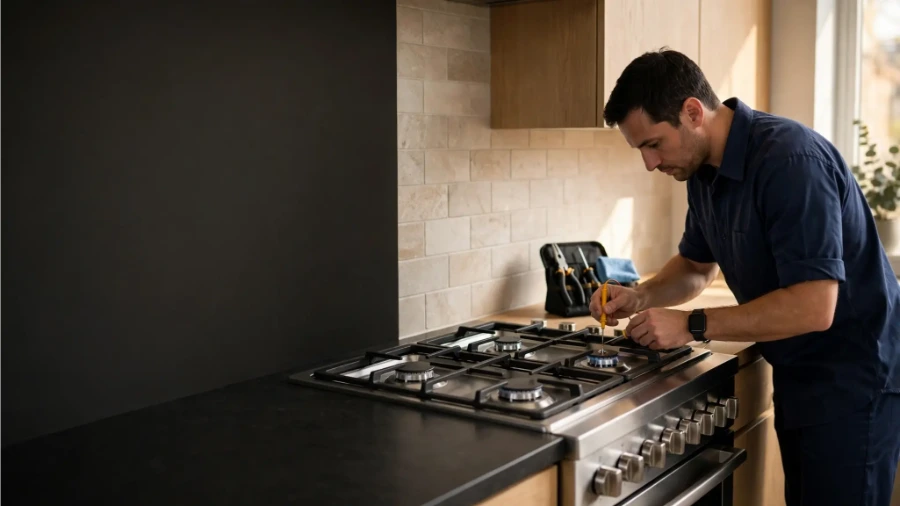
Concord Appliance Care diagnoses and repairs gas, electric coil, and smooth glass stoves and cooktops — freestanding ranges, slide-ins, and built-in cooktops. Local technician. Same-day scheduling available.
Stove & Cooktop Repair or Replace in Concord, NC — When Replacing Makes More Sense
Most stove and cooktop problems are worth repairing. A burner that will not light, a coil that will not heat, or a cracked glass top usually comes down to one failed part — an igniter, an infinite switch, a surface element — and replacing that part costs far less than replacing the whole appliance. The cost of a stove or cooktop repair is almost always substantially less than replacement, even for high-end appliances.
There are two cases where replacement is the honest answer. The first is a basic freestanding range with a failed control board: on a budget unit, the board plus labor can cost more than the range is worth. The second is a unit that has already had the same expensive part fail twice — at that point you are paying for the same repair again. A built-in cooktop is different. Replacing one means a new unit plus installation, and the cooktop is cut into your countertop — so repair usually wins even when the part itself is expensive. Age matters less than the component and the cost: a ten-year-old range with a bad igniter is a simple repair, while a three-year-old range with a failed board may not be.
That is why every visit starts with diagnosis. We test the parts individually, tell you what is wrong and what it will cost, and you approve the price before any part is ordered. If the repair costs more than the unit is worth, you will hear that from us too.
- Diagnosis first — you approve the cost before any repair
- Every burner tested on every setting before we leave
- Gas jobs end with a leak test on every fitting that was touched
Find Your Stove or Cooktop Problem — Start With the Symptom
Pick what your stove or cooktop is doing. Each one links to the diagnosis below — what usually causes it, and what gets tested first.
Gas Burner Clicks but Won’t Light
Clicking with no flame — usually a cap, clogged ports, moisture, or the igniter.
One Burner Won’t Work, Others Do
A single dead burner is a local fault — that burner’s element, receptacle, or switch.
Electric Burner Not Heating
Element, receptacle, then switch — checked in that order.
Burner Stuck on High
Won’t turn down or won’t turn off — switch off at the breaker first, then call.
Cracked Glass Cooktop
Stop using it — spills can reach live parts under the glass. Often only the glass needs replacing.
Entire Cooktop Dead
Nothing works at all — power, breaker, and control, in that order.
Gas Flames Orange or Yellow
Blue is normal. Orange or yellow means incomplete combustion — or the wrong fuel setup.
Touch Controls Not Responding
Lock, a wet panel, cracked glass, or a failed control board — checked in that order.
Hot-Surface Light Stuck On
The light stays on after the cooktop cools — usually the temperature sensor or control board.
What Can Break on a Stove or Cooktop — The Short List
A gas burner, an open coil, a radiant element under glass, and a touch-control board fail in completely different ways. Here are the parts behind nearly every stove and cooktop call we take in Concord — what each one does, and which symptom it usually causes.
Igniter & Spark Electrode
The ceramic spark electrode at each gas burner, fed by the spark module. Causes clicking with no flame, or clicking that never stops after a spill.
Spark Module & Harness
Sends the spark to every burner. A failed module means no burner sparks; a wet igniter switch on a valve stem means nonstop clicking.
Burner Valve & Gas Valve
Controls gas flow to each burner. A sealed burner valve with low flow or a sticky stem gives a weak flame or a burner that will not stay lit.
Infinite Switch
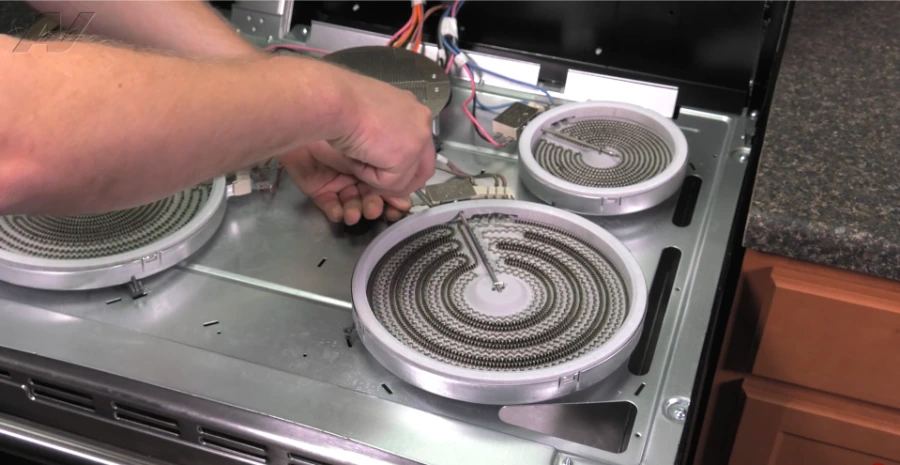
Cycles an electric coil or radiant element on and off to hold the heat you set. Welded contacts leave a burner stuck on high; a failed switch leaves it dead.
Surface & Radiant Elements
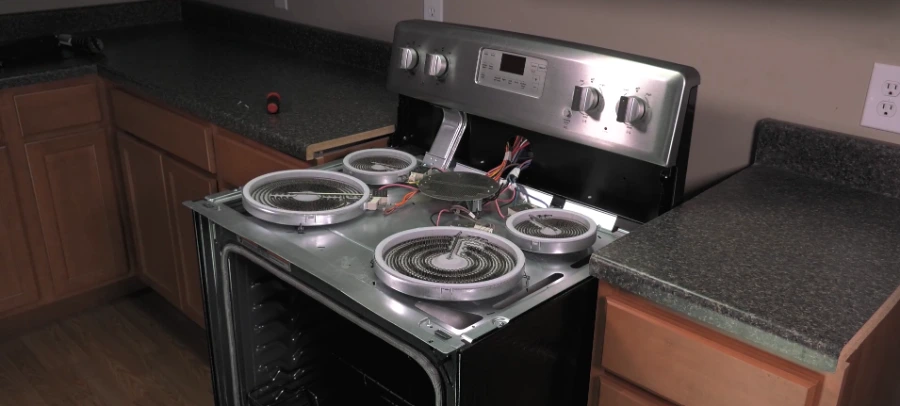
The coil you see, or the ribbon element hidden under smooth glass. A good coil element usually reads 20 to 50 ohms; an open radiant element reads infinite ohms.
Terminal Block & Receptacle
Where power reaches the element. A coil that sparks or heats only when wiggled usually has a burned receptacle block — look for black scorching.
Control Board & Touch Controls
Runs the burners, the timer, and the touch panel. Behind dead touch controls, a hot-surface light that never turns off, or a whole cooktop that will not start.
Regulator, Orifices & Air Shutter
Sets gas pressure and the fuel mix. LP needs smaller orifices and a different regulator setting than natural gas — the wrong setup makes tall yellow flames and soot.
Glass Top & Temperature Sensor
The ceramic glass surface and the sensor that drives the hot-surface light. Cracked glass should not be used — spills can reach live parts underneath.
One note on scope: this page covers the top of the stove — burners, igniters, elements, switches, and glass. Oven bake and broil problems have their own page: oven repair in Concord, NC. And if your over-the-range microwave’s vent fan or light has failed, that is covered on our microwave repair page.
Common Stove & Cooktop Problems We Repair in Concord, NC
For each problem: what you see or hear, the likely causes in the order we check them, and what gets tested.
Gas Burner Clicks but Won’t Light
The burner snaps away but never catches. Check in this order: the burner cap, clogged burner ports, moisture, then the igniter and spark module. A cap sitting crooked on its head will light on one side only or not at all — after cleaning, seat it on its locating pins. Clear clogged ports with a wire or pin, never a toothpick that can snap off inside. After a boil-over, liquid gets into the igniter switch on the valve stem and it clicks nonstop; the ignition module reads the moisture as a grounding event and fires continuously. The switch is dried or replaced, the electrode gap and porcelain are checked for cracks, and the module is tested. A burner that lights but burns unevenly, or will not stay lit, points the same way — cap, ports, then valve. Cleaning the electrode and burner assembly resolves the problem more often than replacement. On models that use one, a faulty thermocouple or flame sensor can also shut the burner off after it lights — the sensor doesn’t confirm ignition, so the gas valve closes as a safety measure. Do not hold the burner on for more than a few seconds while it fails to light.
One Burner Won’t Work When the Others Do
When three burners work and one does not, the fault is local to that burner — not the whole cooktop. On an electric coil top, the usual causes are that burner’s element, its receptacle, or its infinite switch. Try trading it with a same-size coil from another spot: if the problem moves with the coil, the element has failed; if it stays, the socket and switch side is at fault. Look for black scorching on the receptacle, and turn off power before you touch it. On a gas top, the same logic applies — that burner’s cap, ports, electrode, or valve, while the other burners prove the gas supply and spark module are fine.
Electric Cooktop Burner Not Heating
Check in this order: element, receptacle, switch, then power. A good coil element usually reads 20 to 50 ohms on a meter; a coil that sparks or heats only when wiggled usually has a burned receptacle block. A radiant zone that never warms is often an open element, which reads infinite ohms. Coil elements often show hot spots — areas that don’t glow evenly — before they fail completely. A coil that glows on one setting only usually points at the infinite switch. If the whole cooktop is dead rather than one burner, the problem is upstream — see “Entire Cooktop Does Not Operate” below.
Burner Stuck on High or Won’t Turn Off
A burner that will not turn down at all, or keeps heating after the knob is off, is usually a failed infinite switch with welded contacts, or a stuck relay on the control board. Switch the stove off at the breaker — or shut the gas valve behind the range — then call. Do not keep using the burner, and do not try to force the knob. On a coil top, the same switch fault can also scorch the receptacle block, so both get checked and the scorched receptacle is replaced with the switch.
Cracked Glass Cooktop
Stop using it. Shut the breaker off. Spills can run through the crack onto live radiant elements and wiring, and the glass can break further when it heats. The usual question is whether just the glass can be replaced — on many models, yes, and the elements can move over to the new glass. The part number is confirmed first so the right glass comes on the truck. A crack from a dropped pot and a crack from heat stress look different, and the technician will check whether the element underneath was damaged before ordering the glass.
Entire Cooktop Does Not Operate
Nothing works at all — no burner, no light, no response. Check in this order: power, breaker, and control. A tripped breaker or a failed terminal block connection will kill the whole cooktop while the oven on the same range still works — that is the classic sign of one leg of power missing. If power is good at the terminal block, the fault is in the control board or the main wiring. Tell us on the call whether the oven works and whether anything else in the kitchen lost power; it shortens the visit.
Gas Flames Orange or Yellow
Blue is normal. Orange or yellow flames mean incomplete combustion — dust in the air, humidity, blocked burner ports, or a gas supply problem. Clean the ports and watch the flame for a day; if it stays orange, it needs a technician. There is one bigger cause: the fuel setup. LP needs smaller orifices and a different regulator setting than natural gas, and a range set up for the wrong one makes tall yellow flames and soot. Flames that lift off the burner point the same way. This is common after a move — a range moved to a house on a propane tank while still set for natural gas. The fix is swapping in the LP orifices, flipping the regulator, adjusting the low-flame screws, and leak-testing every fitting. If the orange flame comes with a smell of gas, leave the house and call the gas utility first.
Touch Controls Not Responding
Check in this order: the control lock, a wet or greasy panel, cracked glass, then the control board. Many cooktops have a lock that disables the panel — usually a long press on a lock key, and the manual will name it. Wipe the panel dry and clean; a film of grease or water can block the sensors. If the glass is cracked over the touch area, the panel may never read correctly until the glass is replaced. If none of that applies, the fault is the touch controls or the board itself, which is tested rather than guessed at.
Hot-Surface Light Stuck On
The hot-surface light should go out once the cooktop cools. If it stays on for hours, the usual causes are a failed temperature sensor or a failed control board — sometimes a stuck relay. It is not urgent in the way a burner stuck on high is, but it should not be ignored: the light is a safety indicator, and a sensor that reads wrong can also affect how the element cycles. The sensor and the board are tested individually; the sensor is the cheaper of the two and is checked first.
How Concord Appliance Care Diagnoses Your Stove or Cooktop
We test parts individually instead of replacing them one at a time and hoping. Here is the order, by fault family.
Gas ignition
Cap and head seating first, then clogged ports, then moisture in the igniter switch. After that the electrode gap and porcelain are checked for cracks, the spark is checked at every electrode, and the spark module and harness are tested. Before condemning the module, power to the module and wiring continuity are verified — a loose connection or tripped breaker produces the exact same symptom. On gas, the flame pattern is checked at every burner and the pressure is checked at the regulator with a manometer.
Electric coil and radiant glass
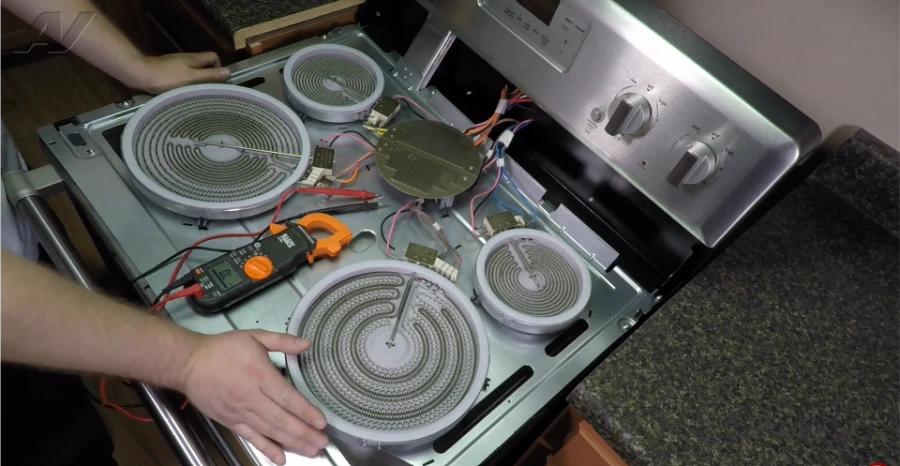
Voltage at the terminal block, then element resistance, then switch output. A good coil element usually reads 20 to 50 ohms; an open radiant element reads infinite ohms. The coil-swap test isolates the element from the socket and switch: trade a same-size coil to another spot and see whether the fault moves with it. Burned receptacles and pigtails are replaced, and the infinite switch that cycles the coil on and off is tested at every knob position.
Gas flow and fuel setup
The sealed burner valve is checked for low flow or a sticky stem, the orifice size is checked against the fuel type, and the regulator conversion is checked. The air shutter is adjusted and every connection is leak-tested. On a house that runs LP from a tank, the orifices, the regulator, and the low-flame screws are all part of the check.
Cracked glass
The crack is assessed first — whether the element underneath was damaged and whether the glass alone can be replaced. The part number is confirmed before the visit so the right glass comes on the truck.
Gas safety comes before all of it. If you smell gas near your stove, do not flip any light switch, use the stove, or unplug anything. Walk out, take everyone with you, and call the gas company or 911 once you are outside. Call us for the repair after the utility clears the leak.
Why Stove & Cooktop Repair Is Not a DIY Job
Two things make stove repair different from most appliance work: gas and 240-volt power. Both punish a wrong guess.
Stop now — call right away: you smell gas; a burner will not turn off; you see sparking or scorching; the glass is cracked and the element underneath is exposed. For a burner stuck on high, switch the stove off at the breaker first, then call.
Less urgent — still book a visit: one burner is out; the hot-surface light is stuck on; the touch panel does not respond; the flame burns orange but there is no smell of gas.
On gas, the risks are a leak and delayed ignition. Lighting a burner by hand bypasses the safety features built into the ignition system, and gas that builds up before it lights can ignite all at once. Do not hold a burner on for more than a few seconds while it fails to light, and never open a gas fitting to “see if gas is coming through.” Before any gas fitting is opened, the connections are leak-tested — and if a leak is found, the utility clears it first.
On electric, a stove or cooktop runs on a 240-volt dedicated circuit. Turn off power at the breaker before you touch a coil or a receptacle — a coil that heats only when wiggled usually has a burned receptacle block, and touching it live is how people get hurt. The same applies to the terminal block, where the power enters the appliance. Testing an element or a switch means working with the power on in places; that is the technician’s job, with a meter, not a guess.
How a Stove or Cooktop Repair Visit Works in Concord, NC
Four steps, from your call to a cooktop you can trust again.
Why Choose Concord Appliance Care for Stove & Cooktop Repair in Concord, NC
A local company that diagnoses first, quotes upfront, and tests every burner before leaving.
A Real Local Company
Concord Appliance Care serves Concord, Harrisburg, Kannapolis, Mount Pleasant, and Midland across Cabarrus County, NC — from a Concord base, with no travel surcharge.
Same-Day Service
Same-day scheduling is available Monday through Friday, 7:00 AM to 7:00 PM, and Saturday, 8:00 AM to 5:00 PM. Sunday is emergency calls only.
Upfront Quote, No Surprises
You approve the cost before any work is done — no surprises after the fact.
Diagnosis First, Upfront Quote
We test the parts individually — element, switch, igniter, valve — and tell you what is wrong and what it will cost before any part is ordered.
All Major Brands
GE, GE Profile, GE Café, Samsung, LG, Whirlpool, Maytag, KitchenAid, Frigidaire, Electrolux, Bosch, Amana, and Hotpoint — gas, electric coil, and smooth glass stoves and cooktops.
Every Burner Tested
Before we leave, every burner is lit or heated on every setting — and on gas jobs, every fitting that was touched gets a leak test.
Is Stove or Cooktop Repair Worth It in Concord, NC? The Honest Answer
It depends on the type of appliance, the failed part, and what a replacement would actually cost you — not just the price tag on a new one.
Basic freestanding range — usually yes, unless it is the board. Simple failures — an igniter, an infinite switch, a surface element, a receptacle — are almost always worth repairing. A failed control board on a budget unit is the exception: the board plus labor can cost more than the range is worth, and that is when we will tell you to replace it.
Built-in cooktop — almost always yes. Replacing a built-in means a new unit plus installation, and the cooktop is cut into your countertop. Repair usually wins even when the part itself is expensive — including a cracked glass top, where the glass alone can often be replaced and the elements moved over.
High-end rangetop — almost always yes. The cost of a stove or cooktop repair is almost always substantially less than replacement, even for high-end appliances, and the gap only grows as the replacement price rises. A rangetop that costs thousands to replace is worth repairing for anything short of a catastrophic failure.
Age is the wrong question on its own. What matters is the component and the cost. A ten-year-old range with a bad igniter is a simple repair. A three-year-old range with a failed board may not be. And a unit that has already had the same expensive part fail twice is telling you something — at that point, replacement is the honest recommendation, and we will say so after diagnosis.
Stove & Cooktop Repair Costs in Concord, NC
We do not publish a flat price for stove and cooktop repair, because the final price depends on the failed part and the model. Everything below is market context from other Concord repair pages — labelled as such, not our prices.
The final price depends on the failed part and the model — which is why the visit starts with diagnosis, not a quote over the phone. You approve the cost before any work is done.
| Symptom | Component Usually Responsible |
|---|---|
| Burner clicks but won’t light | Igniter, spark electrode, spark module |
| Burner stuck on high / won’t turn off | Infinite switch, control board relay |
| Electric burner not heating | Surface element, receptacle, infinite switch |
| One burner dead, others work | That burner’s element, receptacle, or switch |
| Cracked glass cooktop | Glass top (elements often move to the new glass) |
| Entire cooktop dead | Terminal block, control board, main wiring |
| Orange or yellow flames | Burner ports, regulator, orifices (fuel setup) |
What other Concord repair pages quote (market context only — unverified, not confirmed as our prices): True Appliance Repair lists an estimated total of $195–$420 for oven or stove repair in Concord, NC. Trinity Home lists a $125 service call including full diagnosis. C&E Appliance lists a $25 diagnostic fee, waived with completed repairs. Sears lists a $90–$150 diagnostic fee, waived if you proceed, on its 1480 Concord Parkway N location page.
What to Tell Concord Appliance Care When You Call
Nine quick answers that let the technician bring the right parts and keep the visit short.
- Gas or electric? And if gas — natural gas, or LP from a tank?
- Freestanding range, slide-in, or built-in cooktop?
- Which burner or burners? And do the others work?
- Does it click? Does it light at all?
- Is a burner stuck on high? If so, switch it off at the breaker first.
- Is the glass cracked? How big is the crack, and is the element underneath exposed?
- Did it trip a breaker? Does the oven on the same range still work?
- Do you smell gas? If yes, leave the house and call the gas utility first.
- Brand and model number — read the tag under the cooktop on a built-in, on the frame behind the storage drawer, or on the back of a freestanding range.
Where We Repair Stoves & Cooktops in Concord and Cabarrus County, NC
Same-day stove and cooktop repair across Concord and Cabarrus County — houses, condos, townhomes, and rental units.
In Concord we serve Historic Downtown Concord, Afton Village, Christenbury, Laurel Park, Wil-Mar Park, North Concord, Concord Mills, Gibson Mill, Copperfield, and The Vineyards — and every neighborhood in between. We also serve the surrounding communities across Cabarrus County; see the full list on our service areas page. Hours: Monday through Friday, 7:00 AM to 7:00 PM; Saturday, 8:00 AM to 5:00 PM; Sunday, emergency calls only. Call (704) 755-6489.
Stove & Cooktop Repair in Concord, NC — Frequently Asked Questions
Stove or Cooktop Not Working? Call Now.
Call Concord Appliance Care to schedule a diagnostic appointment. We serve Concord, Harrisburg, Kannapolis, and surrounding Cabarrus County — with same-day scheduling available.